
Tree Care Tips · Maui County · Palm Health
Coconut rhinoceros beetle on Maui: what palm owners should check now
The coconut rhinoceros beetle (CRB) is not established on Maui yet, but 2026 trap finds near Kahului and in Waikapu put every palm owner on alert. Check your palms for V-shaped cuts, keep green waste and mulch from piling up, and report anything suspicious to 643-PEST.
Why CRB is in the news on Maui
CRB is an invasive beetle from Southeast Asia. Adults bore into the crown of a palm to feed on its sap. That damage can lead to infection and, over time, a dead palm.
O‘ahu is already fully infested. Maui has stayed ahead of it so far, but 2026 has been a busy year for traps. Here is the timeline from the Maui Invasive Species Committee (MISC):
- November 2023: 17 larvae found in a dead coconut crown in Kihei. That population was eradicated.
- April 1, 2026: One dead adult found in a trap near Kahului Airport, Maui’s first detection since 2023 (Hawai‘i Department of Agriculture and Biosecurity).
- April 7 to 13, 2026: Three dead adults found in traps on Moloka‘i.
- June 4 to 8, 2026: Five dead adults found in traps in Waikapu.
- July 2026: MISC said the finds suggest there may be a breeding population on Maui, though no larvae or breeding site had been found.
The story picked up again this week. On November 17, 2026, the University of Hawai‘i announced that its College of Tropical Agriculture and Human Resilience (CTAHR) is building an AI tool to predict where CRB will spread on Kaua‘i, Maui and Hawai‘i Island, so crews know where to set traps.
The good news: the County of Maui still lists Maui as a non-infested island. Early detection by homeowners is what keeps it that way.
Which trees and plants are at risk
Coconut palms (niu) are the main target. According to MISC, CRB also goes after:
- Coconut palms
- Date palms
- Royal palms
- Fan palms, including the native loulu
- Kalo and banana
- Sugarcane and hala
Loulu are the most at risk. MISC notes a single feeding can lead to a secondary infection that kills the palm. If you have loulu in your landscape, check them often.

Signs of CRB damage on your palms
V-shaped cuts in the fronds
When a beetle bores through new, folded fronds, the leaf opens later with clean V-shaped notches, often at about a 45 degree angle. Fan palms can show scalloped edges or a “snowflake” pattern.
Holes at the base of the fronds
Look for round bore holes, up to about 2 inches wide, where the fronds meet the trunk. Broken young fronds near the top of the crown are another clue.
Damage shows up late
MISC says it can take up to four months for damage to appear. By then, the beetle is often gone. That is why checking breeding spots on the ground matters as much as checking the crown.
Where the beetles breed
CRB does not breed in healthy palms. It breeds in rotting plant material on the ground. MISC lists these as the main breeding spots:
- Green waste piles
- Mulch and wood chip piles
- Compost piles
- Dead palms, especially dead coconut crowns
- Rotting stumps and logs
- Potting mix and bagged soil
The larvae are large white grubs. They grow to about 3 inches, crawl on their side, and curl into a C shape. They take about 5.5 months to grow from egg to adult.
They look a lot like the common Oriental flower beetle grub. The flower beetle grub is smaller, crawls on its back, and has a brown line on the end of its body. A CRB grub does not have that line.

5 steps Maui palm owners can take this season
- Check your palm crowns for V-cuts and holes, especially after trimming opens up the view.
- Do not let green waste pile up. Take it to a processing facility to be chipped, and never leave a pile sitting longer than 4 months.
- Spread mulch 2 inches thick or less so it dries out fast. Gravel, river rock or weed mat are options where they fit.
- Deal with dead palms and rotting stumps before they turn into breeding sites.
- Buy plants, soil and mulch locally, and skip any bags with holes or tears.
Composting at home? Turn the pile often and look for grubs. The County notes that hot composting to a core temperature of 131°F kills the larvae.
Winter Kona storms also mean more downed fronds and branches. The March 2026 Kona low left trees down from Kula to Hana. After any storm, get the debris cleaned up and off your property instead of stacking it in a corner of the yard.
What to do if you find a grub or beetle
Do not move the material, and do not throw the bug away. MISC and the County ask you to:
- Put the grub or beetle in a sturdy, sealed container with some of the material you found it in.
- Take a clear photo or short video with a quarter next to it for scale.
- Write down the date, time and exact location.
- Report it right away at 643pest.org or call the State Pest Hotline at (808) 643-PEST (7378).
Palm damage counts too. If you see V-cuts or bore holes, report them, even if you never see a beetle.
How Island Tree Style keeps palms healthy
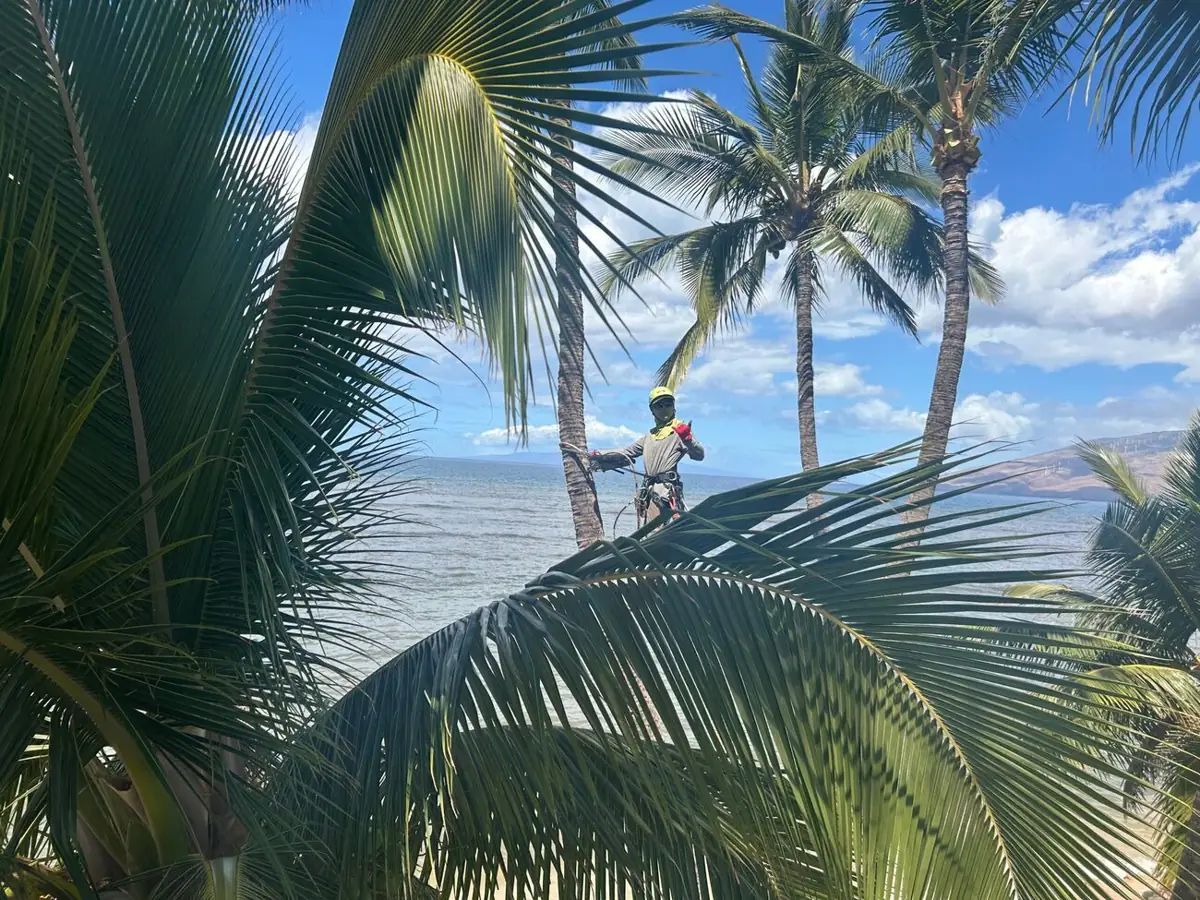
Island Tree Style is a Maui tree care crew led by founder Cliff, with ISA Certified Arborist Doug on our most technical climbing jobs. We work on palms and tropical trees across Maui County, from Hana to Lahaina.
Here is where we fit in your CRB plan:
- Palm trimming: our tree trimming and pruning service includes palm frond removal and deadwood removal, which also gives you a clear look at the crown.
- Dead palm and stump removal: our tree removal crews take out dead and hazardous trees with complete cleanup.
- Ongoing care: a tree maintenance program adds regular health checks and pest and disease monitoring.
- Island-wide coverage: see the areas we serve across Maui, including Kihei, where Maui’s 2023 larvae were found.

Coconut rhinoceros beetle on Maui, answered
Is the coconut rhinoceros beetle on Maui?
Dead adult beetles were caught in traps near Kahului Airport in April 2026 and in Waikapu in June 2026. The County of Maui still lists Maui as a non-infested island because no established population has been confirmed. MISC has said there may be a breeding population, so watching your palms matters.
What does coconut rhinoceros beetle damage look like?
Look for V-shaped cuts in palm fronds, scalloped or snowflake patterns on fan palms, broken young fronds, and round holes up to about 2 inches wide at the base of the fronds. Damage can take up to four months to show.
Who do I call if I find a CRB grub or beetle on Maui?
Report it to the State Pest Hotline at (808) 643-PEST (7378) or online at 643pest.org. Keep the specimen in a sealed container, take a photo with a quarter for scale, and do not move the material you found it in.
Can I still use mulch in my yard?
Yes. Spread it 2 inches thick or less so it dries fast, buy it locally, and do not leave mulch, compost or green waste piles sitting longer than 4 months.
Should I remove a dead coconut palm?
Dead palm crowns and rotting stumps are prime breeding sites, so dead palms should not be left standing for long. If you see grubs or bore holes, report them first and wait for guidance before cutting or moving anything. For a safe removal with full cleanup, call Island Tree Style at (808) 740-0488.
